



Make your own gas at home?

Thread Starter
Lead Lap
Joined: Jul 2007
Posts: 460
Likes: 0
From: California
 Make your own gas at home?
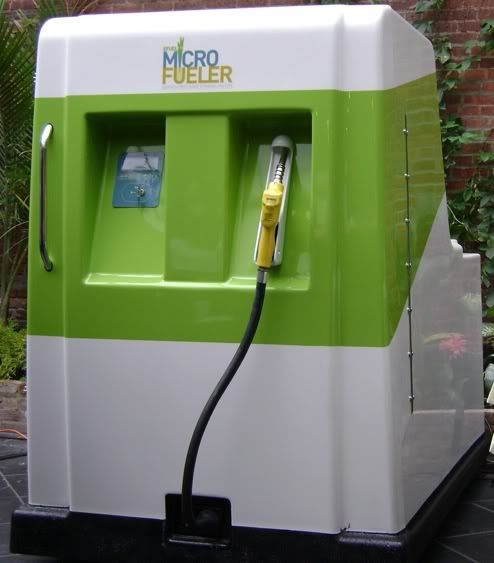
[B]The system takes feedstock (a combination of sugar and yeast) or discarded alcohol, and combines it with water to distill 100% pure ethanol. Turning sugar into gas may sound like the work of mad scientists, but according to CEO Tom Quinn, home ethanol production was advocated and used by Henry Ford when he created the Model T. I imagine that home-made ethanol wasn't as easy to make back then, because if it was, we probably wouldn't have switched to gasoline in the first place.
The MicroFueler produces ethanol using membrane distillation. Sugar, yeast and water are blended together to create the chemical reaction that produces ethanol. After two days, the fermented sugar water is turned into vapor, and the ethanol is separated from the water. By the end of the week, the MicroFueler reservoir will hold 35 gallons of pure ethanol, enough to fill at least two cars. This is a lot like Dean Kamen's water purifier, except in reverse. In fact, creator Floyd Butterfield says the water by-product is clean enough to drink.
The most astounding part is that a car doesn't require pure ethanol to run, due to its higher-than-gasoline octane content. E-Fuel says you can fill up your tank with 75% ethanol and 25% water and your car will run fine.
The price tag may seem steep, but federal, state and local tax credits can bring the price as low as $5000—average cost with credits is more like $7000. The creators say an average home will save around $4200 on gas each year, and the machine will pay for itself in about a year and a half.
That said, people have been doing this on their own for a while. Plans available online estimate a true DIY machine costs about $500 to build, but for those who don't want to run the risk of spontaneous combustion (like me), the MicroFueler seems like a wise alternative. [E-Fuel]
The MicroFueler produces ethanol using membrane distillation. Sugar, yeast and water are blended together to create the chemical reaction that produces ethanol. After two days, the fermented sugar water is turned into vapor, and the ethanol is separated from the water. By the end of the week, the MicroFueler reservoir will hold 35 gallons of pure ethanol, enough to fill at least two cars. This is a lot like Dean Kamen's water purifier, except in reverse. In fact, creator Floyd Butterfield says the water by-product is clean enough to drink.
The most astounding part is that a car doesn't require pure ethanol to run, due to its higher-than-gasoline octane content. E-Fuel says you can fill up your tank with 75% ethanol and 25% water and your car will run fine.
The price tag may seem steep, but federal, state and local tax credits can bring the price as low as $5000—average cost with credits is more like $7000. The creators say an average home will save around $4200 on gas each year, and the machine will pay for itself in about a year and a half.
That said, people have been doing this on their own for a while. Plans available online estimate a true DIY machine costs about $500 to build, but for those who don't want to run the risk of spontaneous combustion (like me), the MicroFueler seems like a wise alternative. [E-Fuel]

Lexus Fanatic


Joined: Oct 2003
Posts: 94,576
Likes: 265
From: Virginia/D.C. suburbs
This will not work in normal gasoline-engine cars, which, by the nature of their fuel systems, can only tolerate E10 (a 90-10 gas-alcohol mix) E10, BTW, is Federally required in many areas. Ethanol mixtures higher than E10 deteriorate a number of fuel-system components in gas-engine cars. It can, however, be used in flex-fuel vehicles and those (mostly from GM) designed for E85 (85-15 gas-alcohol mix). If used in a flex-fuel car, however, it may be subject to a motor-fuel tax, which varies from state to state. I'm not enough of a lawyer to know all the details, but, in some cases, using homemade fuels without paying the tax on it is a legal offense.....people have been fined for making diesel biofuel at home and not paying the diesel tax on it.
The old saying that there are two certainties in life (death and taxes) didn't come about without reason.
The old saying that there are two certainties in life (death and taxes) didn't come about without reason.

Lead Lap
Joined: Apr 2008
Posts: 543
Likes: 0
From: NYC
This will not work in normal gasoline-engine cars, which, by the nature of their fuel systems, can only tolerate E10 (a 90-10 gas-alcohol mix) E10, BTW, is Federally required in many areas. Ethanol mixtures higher than E10 deteriorate a number of fuel-system components in gas-engine cars. It can, however, be used in flex-fuel vehicles and those (mostly from GM) designed for E85 (85-15 gas-alcohol mix). If used in a flex-fuel car, however, it may be subject to a motor-fuel tax, which varies from state to state. I'm not enough of a lawyer to know all the details, but, in some cases, using homemade fuels without paying the tax on it is a legal offense.....people have been fined for making diesel biofuel at home and not paying the diesel tax on it.
The old saying that there are two certainties in life (death and taxes) didn't come about without reason.
The old saying that there are two certainties in life (death and taxes) didn't come about without reason.
Just curious as to what you think is going to happen when PHEVs & EVs become more mainstream.
Id prefer a water engine. In water...hydrogen seperation...out oxygen. Would be nice.
Electricity cost will go up. There's no escape.
Lead Lap
Joined: Apr 2008
Posts: 543
Likes: 0
From: NYC

Pole Position


Joined: Jan 2006
Posts: 2,816
Likes: 7
From: UK

There is no escape..
Trending Topics

Out of Warranty


Joined: Aug 2001
Posts: 14,925
Likes: 13
From: Houston, Republic of Texas
Making your own ethanol might get you a visit from these guys . . .

Considering the tight restrictions on home distillation of ethanol, I don't see how this is practical unless you first get yourself an orange Dodge Charger . . .

and a hot sister named Daisy . . .

Hey, this might be a good idea after all!
Considering the tight restrictions on home distillation of ethanol, I don't see how this is practical unless you first get yourself an orange Dodge Charger . . .
and a hot sister named Daisy . . .
Hey, this might be a good idea after all!
ClubLexus Stories
Celebrating Lexus & Toyota from Around the Globe
Top 10 Most Confusing Things Lexus Has Ever Done!
Joe Kucinski
2026 Lexus ES Review: Lexus Re-Embraces Founding Principles
Michael S. Palmer
10 Lexus Bargains That are Cheaper Than a New Toyota RAV4
Joe Kucinski
8 Weirdest Things Lexus Has Ever Built
Verdad Gallardo
10 Lexus Designs That Have Aged Like Fine Wine
Verdad Gallardo
8 Tips for Improving Your Hybrid or Plug-in Hybrid's Efficiency!
Michael S. Palmer
10 Best Lexus Models No One Remembers
Joe Kucinski
TRD Off-Road Premium: Best 2026 4Runner, Except This One Thing
Michael S. Palmer
Top 10 Lexus & Toyotas to Drive Before You Die!
Joe Kucinski
Lexus Champion
Joined: Oct 2002
Posts: 11,204
Likes: 12
From: The Woodlands, TX
If used in a flex-fuel car, however, it may be subject to a motor-fuel tax, which varies from state to state. I'm not enough of a lawyer to know all the details, but, in some cases, using homemade fuels without paying the tax on it is a legal offense.....people have been fined for making diesel biofuel at home and not paying the diesel tax on it.
Last edited by bagwell; May 13, 2008 at 10:35 AM.

Lexus Champion
Joined: Jan 2003
Posts: 1,979
Likes: 0
From: ca
I bet if you buy one of these machines the IRS gets sent a copy of your home address. Kinda like a guy I know who bought a top of the line color photocopier for his home back in the 90's the Secret Service paid a visit to him and ultimately locked him up for counterfitting. Back then all purchasers of this particular model had their records sent and reviewed by the SS.
I know a guy that makes bio disel in his garage using restarant throw away grease. He hasn't been visited yet....
I know a guy that makes bio disel in his garage using restarant throw away grease. He hasn't been visited yet....


Lexus Fanatic
Joined: Oct 2003
Posts: 94,576
Likes: 265
From: Virginia/D.C. suburbs
You just answered your own question. Motor fuel taxes only apply to gasoline, ethanol, or diesel oil (petroleum or vegetable-oil based).....liquid fuels, not electricity for electric cars.
You're already paying utility taxes on your monthly electric bill.....use more of that electricity for your car and you'll pay the appropriate utility tax.
Last edited by mmarshall; May 13, 2008 at 01:59 PM.



(you do know you'll take 70A for 3 - 4 hours to charge the Tesla, right? And the normal home has 100A service, so you'd best not run your A/C while the Tesla is charging or you'll be popping breakers - unless you opt for the premium 200A residential service.)
Last edited by lobuxracer; May 13, 2008 at 10:42 PM.